Disclosure: This post contains affiliate links. If you book through them, we may earn a small commission at no extra cost to you. See our full Affiliate Disclosure.
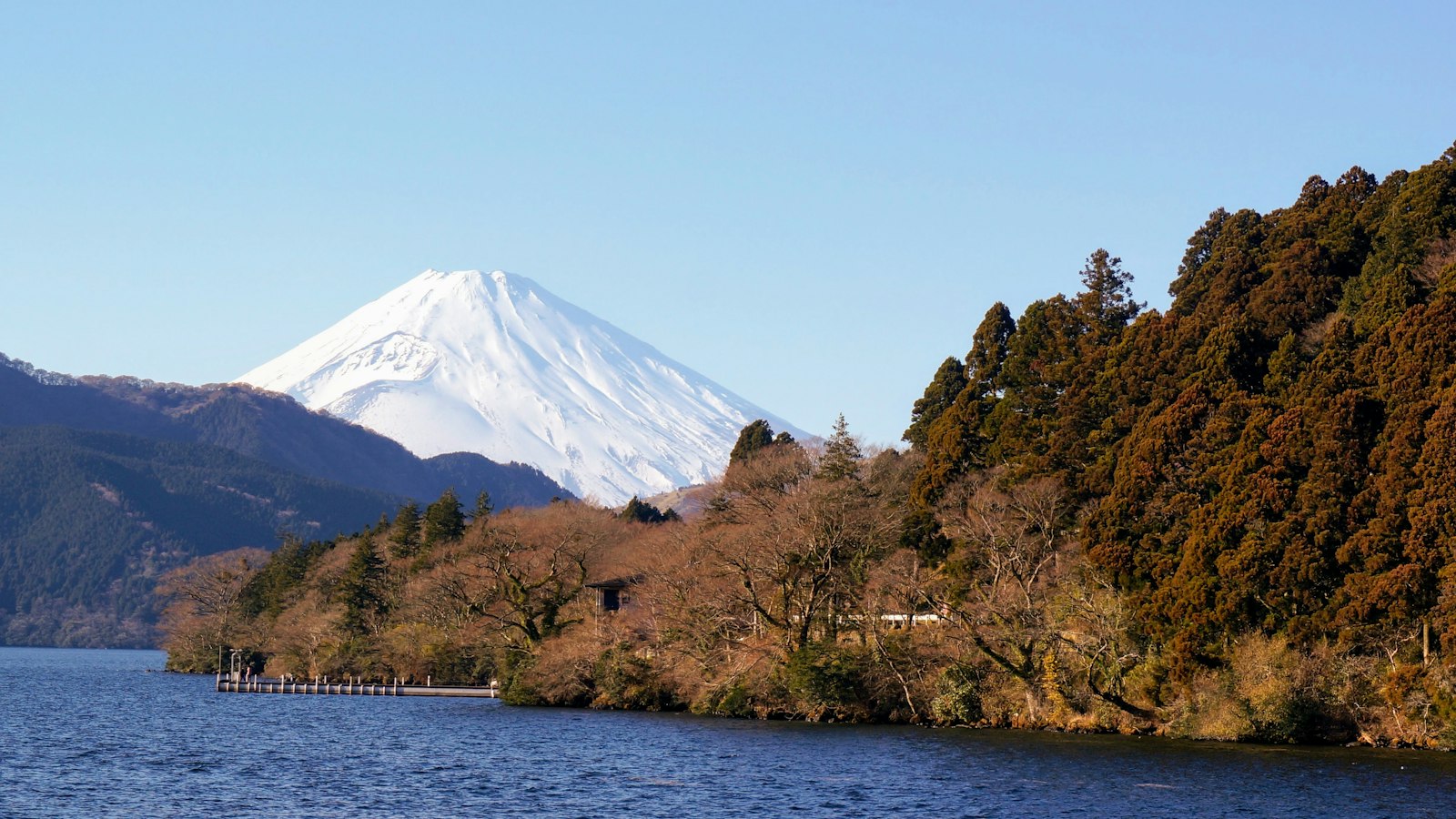
Most people plan a Mt Fuji trip in the wrong season, and then plan the wrong kind of trip.
The wrong season is summer. The wrong kind of trip is the rushed day trip, which puts you at the lake in the early afternoon — by which time the cloud has usually won. Staying the night near the mountain in winter fixes both problems at once: you get the clearest air of the year, and you get the early morning, which is when Fuji is most often out.
This guide is about where to sleep for that. If you only want the day-trip logistics, those are in Mt Fuji day trip from Tokyo.
Winter really is the season — here are the numbers
This isn’t folklore. The Tokyo Metropolitan Government counts how many days Mt Fuji is visible from its own building in Shinjuku, photographed each morning, and publishes the result. The monthly averages tell the whole story:
| Month | Average days Fuji was visible from the Tokyo Metropolitan Government Building |
|---|---|
| January | 19.1 |
| December | 18.1 |
| November | 11.3 |
| June | 1.8 |
Nineteen days in January against fewer than two in June. That is not a small seasonal wobble — it is the difference between a likely view and a lottery ticket. (These are the metropolitan government’s own published averages from its Shinjuku observation point, collected from 2003 onwards.)
The reason is the winter pressure pattern the Japan Meteorological Agency calls seikō-tōtei — high pressure to the west, low to the east. It pushes dry north-westerly air across the country, and while it dumps snow on the Japan Sea side, it leaves the Pacific side cold, dry and startlingly clear. That dryness is what lets you see a mountain from 100km away.
One thing the numbers don’t show: time of day matters as much as month. Fuji is most reliably out at first light, and cloud builds as the day warms. Staying overnight is the only way to be standing in front of it at 7am.
First question: do you need to leave Tokyo at all?
If a Fuji sighting would be a bonus rather than the point of the trip, stay in the city and treat the mountain as a winter morning’s luck.
- Tokyo Metropolitan Government Building observation decks (Shinjuku, 45th floor, 202m). Free. The south deck is open 9:30–22:00 and the north deck 9:30–17:30. The city’s own page says plainly that December to February, when the air is cold and the visibility good, are the months you can most often see Fuji from up there.
- Tokyo City View at Roppongi Hills (52nd floor, 250m) also states on its official site that Fuji is visible on clear days.
A south-west-facing room high up in Shinjuku or Roppongi can do the same job. If that’s your plan, my area-by-area guide to where to stay in Tokyo covers the trade-offs, and you can browse Tokyo hotels on Agoda.
But if you want the postcard — the mountain filling the window, snow on it, reflected in water — you need to sleep closer.
The four bases people actually choose
| Base | What the view is like | Winter consideration |
|---|---|---|
| Kawaguchiko / Yamanakako | The postcard. Fuji rises straight out of the lake, close and very large | Coldest and most snow-prone of the four; roads can ice |
| Hakone | Fuji across Lake Ashi, further off and smaller; an onsen trip first, a Fuji trip second | High and cold, and the mountain stays hidden on plenty of otherwise decent days |
| Gotemba | Fuji large and close from the town itself, no lake in the frame | Sits on the chain-regulation stretch of the expressways if you drive |
| Mishima / Numazu | Fuji further off, seen over the town | Lowest and mildest of the four; least likely to be disrupted by snow |
Kawaguchiko and Yamanakako — for the view itself
Pick this if the mountain is the reason for the trip. It is close enough that the view is the room, not a detail in it. Fuji Lake Hotel on the Kawaguchiko shore, for instance, says on its own site that you can enjoy Fuji and the lake from all over the property.
Browse the area: Fujikawaguchiko hotels, or the quieter Yamanakako.
Book a room that faces the mountain, and confirm it in writing. “Fuji view” is a room category at most of these places, not a property-wide guarantee, and the cheaper rooms usually face the other way.
Hakone — for the onsen, with Fuji as a bonus
Hakone is the better holiday and the worse Fuji bet. Come for the hot springs, the ropeway and the art museums, and treat a clear morning over Lake Ashi as a gift. Some properties do aim at the view directly — Hotel Green Plaza Hakone in Sengokuhara advertises a Fuji-facing open-air bath and Fuji-view rooms on its official site.
More options: Hakone hotels and ryokan. For how Hakone compares with the other classic escapes, see Hakone vs Nikko vs Kamakura.
Gotemba — big mountain, simple logistics
Gotemba sits on Fuji’s eastern flank, so the mountain looms over the town without you having to reach a lakeshore at dawn. Mars Garden Wood Gotemba describes itself as a resort hotel with a panoramic Fuji view and specifically mentions the snow-covered peak. It pairs naturally with the outlet mall if shopping is on the list.
See Gotemba hotels.
Mishima and Numazu — the low-risk choice
Lower altitude, milder winters, less chance of snow rearranging your plans, and a shinkansen station. The trade-off is distance: Fuji is a handsome presence on the skyline rather than a wall in front of you. The Fujisan Mishima Tokyu Hotel, a minute from Mishima Station, says on its official site that its top-floor bath around 60m up looks out at Fuji — a rare thing to get straight off a bullet train.
See Mishima hotels.
Getting there from Tokyo
- Train to Kawaguchiko: the Fuji Excursion limited express runs direct from Shinjuku in as little as 1 hour 53 minutes for ¥4,200 all in (¥2,580 fare plus ¥1,620 limited express charge), four round trips a day, with extra services in busy periods. Four a day means booking ahead.
- Highway bus to Kawaguchiko: Busta Shinjuku to Kawaguchiko Station, about 1 hour 45 minutes, from ¥2,000 with the online discount. Cheaper than the train and often just as quick — but traffic-dependent.
- Train to Hakone: the Odakyu Romancecar reaches Hakone-Yumoto from Shinjuku in as little as 75 minutes with no change. The limited express charge is ¥1,150 ticketless or ¥1,200 at a counter, on top of the basic fare.
- Driving: think twice in January and February. The stretches of the Tomei and Shin-Tomei expressways around Gotemba IC and Gotemba JCT, and from Oi-Matsuda IC through to Nagaizumi-Numazu and Numazu IC, are designated chain-regulation sections under the national winter road framework. Chain regulation means what it says: winter tyres alone may not get you through.
For how these journeys compare with hops inside the city, see travel times between Tokyo’s areas.
One thing you can’t do in winter: climb it
Mt Fuji is a summer-only climb, and the official season is short. In 2026 the Yoshida Trail on the Yamanashi side was open 1 July–10 September and the three Shizuoka-side trails 10 July–10 September, with an entry fee of ¥4,000 per person per climb and the gates shut from 14:00 to 03:00. Dates for 2027 have not been announced.
Outside that window the mountain is a serious alpine environment and the trails are not open to visitors. A winter Fuji trip is about looking at it — which, as the numbers above show, is exactly when looking at it works.

Ayako’s Local Tip
Build in two mornings, not one. Nobody here assumes a single sunrise will deliver — even in January, the best month in Tokyo’s own count, the mountain is out on 19 days of the month and missing on the other twelve. Two nights near Fuji turns a coin flip into a near-certainty, and the second morning costs you one hotel night rather than a whole repeat trip out from Tokyo.
Bottom line
- Go in December, January or February. Fuji is visible from central Tokyo on around 18–19 days a month in mid-winter, against fewer than two in June.
- Kawaguchiko for the view, Hakone for the onsen, Gotemba for easy access, Mishima for the mildest weather.
- Stay the night and get up early. The mountain is out at dawn and hides by lunchtime; a day trip from Tokyo arrives after the best window has closed.
- Book a Fuji-facing room explicitly — it is a room type, not a property feature.
- Planning around the seasons more broadly? My autumn leaves guide covers the month before this one.
Visibility statistics from the Tokyo Metropolitan Government; fares, timings and climbing dates checked on the operators’ and official sites on 20 September 2026. Fares and conditions change — confirm before you travel.
Leave a Reply