Disclosure: This post contains affiliate links. If you book through them, we may earn a small commission at no extra cost to you. See our full Affiliate Disclosure.
Most “where to stay in Tokyo” guides give you three neighbourhoods and a shrug. But the honest answer depends on a trade-off nobody states plainly: in Tokyo you are not choosing convenience — everywhere is convenient. You are choosing what your money buys and what your evenings feel like.
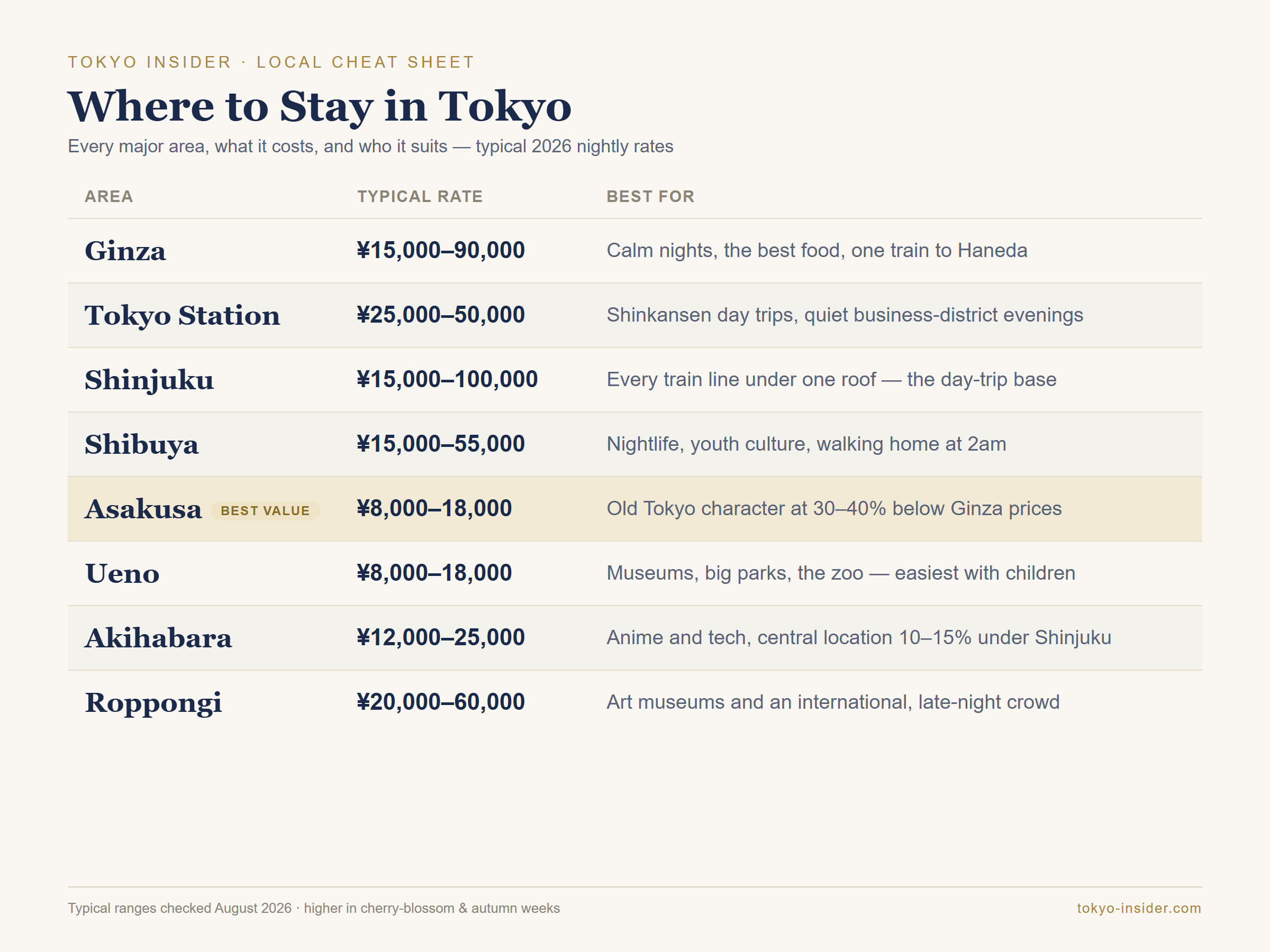
I run two businesses in central Tokyo and field this question constantly. Here is every major area, what it actually costs in 2026, and who each one is genuinely for.
The price reality first
The single most useful fact: the same business-hotel chain costs 20–30% more in Ginza than in Asakusa or Ueno. Not a better room — the same room, in a different postcode.
So the real question becomes: is the extra ¥5,000 a night buying you something you’ll actually use? Sometimes yes (a calm 10pm walk home, a direct airport train). Often no. That framing decides more than any hotel review.
Central and polished
Ginza — ¥15,000–90,000
My neighbourhood, so weigh the bias. Ginza is the most walkable, best-eating, quietest-at-night district in central Tokyo, and Higashi-Ginza has a direct train to Haneda. The trade-off is price and a nightlife that dresses up rather than gets loud.
Best for: food-led trips, couples, jet-lagged sleepers, anyone flying via Haneda.
→ Check rates: Mitsui Garden Ginza Premier · Tokyu Stay Ginza — or read my full Ginza hotel guide.
Tokyo Station / Marunouchi — ¥25,000–50,000
A business district that empties at night: red-brick station architecture, excellent food halls, and almost no street noise after nine. If your trip includes Kyoto, Kanazawa or Hiroshima, sleeping above the Shinkansen platforms saves real time and luggage-hauling.
Best for: Shinkansen-heavy itineraries, quiet evenings, short business-plus-leisure trips.
→ Check rates: Hotel Metropolitan Marunouchi · Marunouchi Hotel
The big two
Shinjuku — ¥15,000–100,000
Every train line in one station, which makes it the default for people cramming in day trips. Enormous, electric, and exhausting — and the sub-area matters enormously: the west side is calm hotel towers, the east side stays loud all night.
Best for: first-timers with a packed schedule, Hakone and Mt Fuji day trips.
→ Check rates: Century Southern Tower · Park Hyatt Tokyo
Shibuya — ¥15,000–55,000
The most transformed district of the past decade, and the priciest per unit of quality right now. Worth it if your Tokyo is streetwear, live music and izakaya crawls you walk home from.
Best for: under-35 energy, nightlife, Harajuku on your doorstep.
→ Check rates: Cerulean Tower Tokyu · Mustard Hotel Shibuya
I compare these three in depth in Ginza vs Shinjuku vs Shibuya.
The value side of the city (where locals send friends)
Asakusa — ¥8,000–18,000 · the best value in Tokyo
Old-Tokyo streets around Senso-ji temple, riverside walks, and mid-range hotels running 30–40% below Ginza for comparable rooms. You trade about 20 minutes of train time to the west-side sights for a genuinely characterful neighbourhood and a materially cheaper trip.
Best for: budget-conscious travelers who still want atmosphere; longer stays.
→ Check rates: The Gate Hotel Asakusa · Asakusa View Hotel · MIMARU SUITES (families)
Ueno — ¥8,000–18,000
Five minutes from Asakusa, wrapped around a park containing the national museums and the zoo. It is the easiest central area to travel with children, and the Skyliner from Narita stops here.
Best for: families, museum days, arriving from Narita.
→ Check rates: Mitsui Garden Hotel Ueno · Hotel Graphy Nezu — see also my guide for families.
Akihabara — ¥12,000–25,000
The underrated middle option: dead-central on the Yamanote loop, roughly 10–15% cheaper than equivalent Shinjuku hotels, and obviously the place to be if anime, games or electronics are on your list.
Best for: pop-culture trips, central location on a mid budget.
→ Check rates: remm Akihabara
Roppongi — ¥20,000–60,000
Art museums by day, an international crowd by night. Worth considering if those are your priorities — otherwise the nightlife blocks are the one part of Tokyo I would not choose for a first solo trip.
Best for: contemporary art, an international social scene.
Pick in one line
- First trip, want it easy and memorable? Ginza or Shinjuku.
- Watching the budget without sacrificing character? Asakusa. This is the answer for most people who ask me.
- Traveling with children? Ueno or Asakusa.
- Day trips to Kyoto or beyond? Tokyo Station.
- Out late most nights? Shibuya.
- Traveling alone as a woman? Ginza or Marunouchi — more in my solo travel guide.

Ayako’s Local Tip
Don’t split your stay between two areas to “see more.” Visitors do this constantly and it costs them half a day: packing, checking out, hauling luggage across a station at rush hour, waiting for the next check-in. Tokyo is small enough that one base works for a whole week. Pick one, unpack once.
Bottom line
Asakusa is the value answer, Ginza is the comfort answer, Shinjuku is the logistics answer. Everything else is a variation on those three. Whichever you pick, you’ll be 15–30 minutes from everywhere else in the city — so choose the neighbourhood you want to walk around at 9pm, not the one closest to a sight you’ll visit once.
Getting in from the airport is the other half of arrival day: see Narita or Haneda to Tokyo.
Coming in November? Where to stay for Tokyo’s autumn leaves narrows these areas down to the ones that put you nearest the colour.
Rates are typical 2026 ranges and rise sharply in cherry-blossom and autumn weeks. Check current prices before booking.

Thanks for reading! I’m Ayako, a business owner in Ginza writing honest guides from inside Tokyo. More about me here.
Leave a Reply