Disclosure: This post contains affiliate links. If you book through them, we may earn a small commission at no extra cost to you. See our full Affiliate Disclosure.
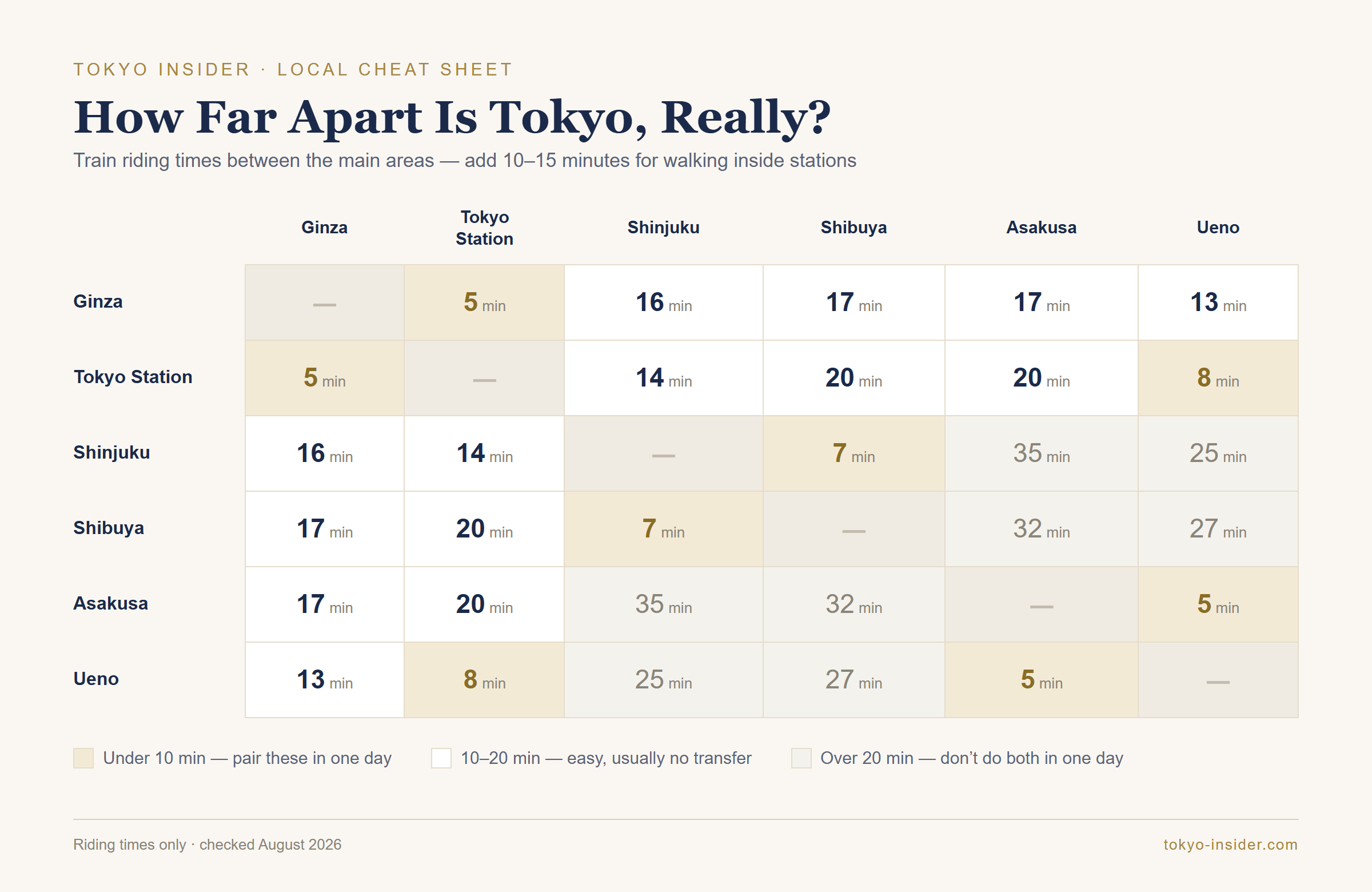
“Is Ginza far from Shibuya?” is one of the most common questions I get from visiting friends — and the honest answer is the one that surprises them: almost nothing in central Tokyo is far from anything else. The distances that look intimidating on a map are 15 to 20 minutes on a train.
What actually eats your day isn’t the ride. It’s the walking inside stations, the transfers, and the planning mistakes that come from not knowing which areas naturally pair up. Here is the map in my head after years of doing this every day.
Travel times between Tokyo’s main areas
| From → To | Time | How |
|---|---|---|
| Ginza → Tokyo Station | 5 min | Marunouchi Line (or a 10-min walk) |
| Shibuya → Harajuku | 2 min | JR Yamanote (or 15-min walk) |
| Ueno → Asakusa | 5 min | Ginza Line |
| Shibuya → Shinjuku | 7 min | JR Yamanote |
| Ginza → Ueno | 13 min | Ginza Line, no transfer |
| Tokyo Station → Shinjuku | 14 min | JR Chuo Rapid |
| Ginza → Shinjuku | 16 min | Marunouchi Line, no transfer |
| Ginza → Shibuya | 17 min | Ginza Line, no transfer |
| Ginza → Asakusa | 17 min | Ginza Line, no transfer |
| Tokyo Station → Shibuya | 20 min | JR Yamanote |
| Shinjuku → Ueno | 25 min | JR Yamanote |
| Shibuya → Asakusa | 32 min | Ginza Line end to end — the longest common ride |
| Ginza → Haneda Airport | ~30 min | Asakusa Line direct from Higashi-Ginza |
Times are riding time between stations. See the next section for what to add.
The hidden cost nobody budgets for: walking inside stations
This is the single most useful thing I can tell you. Add 10–15 minutes to every journey for the walking that Google Maps under-counts:
- Shinjuku Station is the busiest station on earth. Crossing it between lines can genuinely take 15 minutes. If your hotel is “5 minutes from Shinjuku Station,” ask which exit — there are over 200.
- Tokyo Station is a small city. Yaesu side to Marunouchi side is a 10-minute walk underground.
- Transfers between different companies (JR ↔ subway) often mean exiting one system and walking to another entrance.
Rule of thumb: a “17-minute” ride is a 30-minute door-to-door reality. Plan four or five destinations a day, not eight.
Which areas pair naturally in one day?
Some combinations are effortless because they sit on the same line. These are the pairs locals treat as one outing:
- Shibuya + Harajuku + Omotesando — walkable to each other. One afternoon.
- Ueno + Asakusa — 5 minutes apart. Museums in the morning, old Tokyo after lunch.
- Ginza + Tsukiji + Tokyo Station — all within walking distance of each other. My full Ginza day plan covers exactly this loop.
- Shinjuku + Shibuya — 7 minutes apart, but both are exhausting. Do one properly rather than both badly.
And the combination to avoid in one day: Asakusa + Shibuya. They’re at opposite ends of the Ginza Line, and doing both means an hour of your day underground.
So does your hotel location actually matter?
Yes — but not for the reason most people think. Since everywhere is 15–30 minutes from everywhere, you’re not choosing proximity to sights. You’re choosing what your mornings and nights feel like.
- Want quiet evenings and easy airport access? → Ginza
- Want every train line under one roof for day trips? → Shinjuku
- Want to walk home from the bars? → Shibuya
I compare all three in detail in Ginza vs Shinjuku vs Shibuya. Traveling alone or with kids changes the calculation too — see my guides for solo female travelers and families.
Three things that make all of this easier
1. An IC card (Suica or PASMO) on your phone. Add it to Apple Wallet or Google Wallet before you land, top it up with a card, and tap through every gate without thinking about fares. Nobody buys paper tickets anymore.
2. Working data from the moment you land. Every journey above assumes you have live maps in your hand. An eSIM installed before departure costs less than one train ride — my honest comparison of Japan eSIMs covers which to buy. Already know you want Klook’s? Check current Klook eSIM prices for Japan.
3. A JR Pass if day trips are part of the plan. Central Tokyo itself doesn’t need one — everything above is a short subway or JR Yamanote ride — but if Hakone, Nikko, Kamakura or a trip further out is on the itinerary, a rail pass often pays for itself within one or two rides.
Check current JR Pass and regional pass prices on Klook
If your days will be subway-heavy, the Tokyo Subway Ticket (24/48/72-hour unlimited subway pass, sold to foreign visitors) often pays for itself on day one.
→ Check Tokyo Subway Ticket prices

Ayako’s Local Tip
When Google Maps offers you a route with one transfer saving three minutes, take the slower direct train instead. Three minutes on paper becomes twelve in reality once you factor in the platform walk, and you keep your seat. Locals optimize for “no transfer,“ not for the fastest number on the screen.
Bottom line
Central Tokyo is smaller than it looks: almost every pair of major areas is 5 to 20 minutes apart by train, with no transfer needed for most of them. Budget 30 minutes door to door, plan four destinations a day rather than eight, and pick your hotel for the neighborhood’s character rather than its distance to anything. Sort your data before you land — check current Klook eSIM prices for Japan.
Travel times are approximate riding times as of August 2026 and vary by time of day. Always check a live routing app on the day.
If those short hops add up to several rides a day, a subway pass can be cheaper than paying per ride. Tokyo Subway Ticket (24/48/72-Hour): Is It Worth It in 2026? works through the numbers.

Thanks for reading! I’m Ayako, a business owner in Ginza writing honest guides from inside Tokyo. More about me here.
Leave a Reply