Disclosure: This post contains affiliate links. If you book through them, we may earn a small commission at no extra cost to you. See our full Affiliate Disclosure.

Every week I watch visitors in Ginza huddle outside cafes, hunting for free Wi-Fi. Here’s the truth from someone who lives here: free Wi-Fi in Tokyo is patchy, slow, and never there when you actually need it — like when you’re lost in Shinjuku Station trying to load Google Maps.
The fix costs less than a coffee: an eSIM you install before your flight. No airport SIM counter queues, no pocket Wi-Fi router to charge and return. You land, your phone connects, done.
But the eSIM market in 2026 is crowded and confusing, and prices for the same data can differ by 3x. This guide compares the four providers I actually recommend to friends and customers visiting Japan, based on what matters here on the ground: which Japanese network you’ll ride on, real prices, and how painful setup is.
Who this guide is NOT for
- Your phone is carrier-locked or doesn’t support eSIM. Check before you buy — older phones and some carrier-locked US phones can’t use any of these. A physical SIM or pocket Wi-Fi is your backup.
- You’re staying more than 90 days. Long-stayers should look at Japanese prepaid carriers instead; tourist eSIMs get expensive past a month.
- You need a Japanese phone number. These are data-only plans. For calls, use LINE, WhatsApp, or FaceTime — that’s what everyone in Japan uses anyway.
How I judged them (3 things that actually matter)
1. Which Japanese network you get. This is the one thing most comparison sites gloss over. Japan has three major networks: docomo (widest rural coverage), SoftBank (strong in cities), and KDDI/au. If you’re only doing Tokyo–Kyoto–Osaka, any of them is fine. If your itinerary includes Hokkaido, the Japan Alps, or smaller islands, you want docomo.
2. Price per GB — at the size you’ll actually use. Most visitors use 1–2GB per day with heavy Google Maps and photo uploads. For a typical one-week trip, plan for 8–15GB. Headline “from $1.50” prices are real but tiny; compare at 10GB or more.
3. Setup and support. All four below deliver instantly by QR code. The difference shows when something goes wrong at 11pm at Haneda Airport.
Quick comparison (prices checked July 2026)
| Provider | Network in Japan | Typical price | Best for |
|---|---|---|---|
| Klook eSIM | SoftBank / docomo (varies by plan — shown on each listing) | From $1.50 (1GB/7 days); daily unlimited plans around $2/day | Short trips; bundling with JR Pass or attraction tickets |
| Ubigi | docomo | 10GB/30 days $17.99; 20GB/30 days $24.99 | Rural itineraries (Hokkaido, Alps); best network for the price |
| Airalo | SoftBank + KDDI/au | 20GB/30 days about $26 | Longer trips on a fixed budget; huge user base |
| Saily | SoftBank | 1GB $3.79 up to 20GB $39.99 | Very light users; simple app |
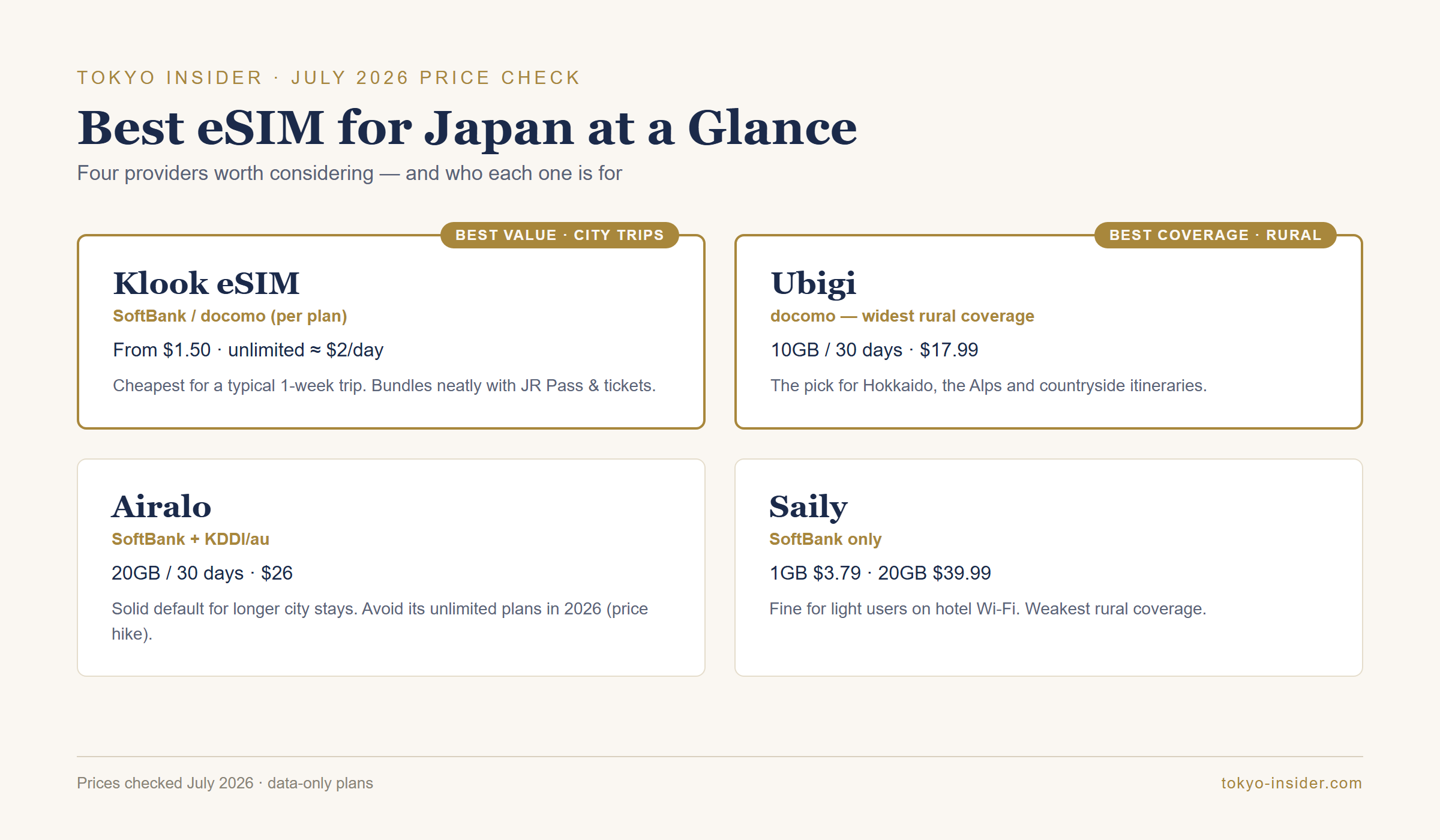
Klook eSIM — best value for a typical one-week trip
Klook is better known for tours and JR Pass sales, but their eSIMs have quietly become some of the cheapest tourist data in Japan — starting at $1.50 for 1GB/7 days, with daily-unlimited options hovering around $2 a day in 2026. The plans run on proper Japanese networks (each listing states clearly whether it’s SoftBank or docomo, and whether hotspotting is allowed — check this before you buy).
Pros: lowest prices at small-to-mid sizes; network and hotspot policy clearly labeled; if you’re already buying a JR Pass or teamLab tickets on Klook, everything sits in one app and one currency.
Cons: the plan lineup changes often, which makes comparison shopping slightly annoying; support is Klook’s general helpdesk rather than an eSIM specialist.
→ Check current Klook eSIM prices for Japan
Ubigi — best network coverage per dollar
Ubigi rides NTT docomo, the network with the widest coverage in rural Japan. At $17.99 for 10GB/30 days (or $24.99 for 20GB), it’s the one I suggest to anyone heading beyond the big cities — skiing in Hokkaido, hiking the Alps, or visiting family in the countryside.
Pros: docomo coverage; fair fixed prices with a generous 30-day window; reliable, boring, in the best way.
Cons: the app is less polished than Airalo’s or Saily’s; small plans are pricier per GB than Klook’s.
Airalo — the safe default, but watch the unlimited pricing
Airalo is the world’s biggest travel eSIM brand, and their Japan plans (SoftBank + KDDI) are solid in cities. A 20GB/30-day plan at around $26 is decent value for longer stays. One honest warning: Airalo raised their Japan unlimited prices sharply in early 2026 — the 7-day unlimited went from about $15 to $27, and the 30-day to around $72. Their fixed-data plans remain fair; the unlimited ones are hard to recommend now.
Pros: mature app, easy top-ups, dual-network redundancy in cities.
Cons: unlimited plans are now overpriced; coverage thinner than docomo in remote areas.
Saily — fine for light users, weakest for exploring
Saily (from the NordVPN team) has a clean app and per-GB pricing from $3.79 for 1GB. But it runs on SoftBank only, which is the weakest choice for rural Japan, and its 20GB price ($39.99) is well above Airalo and Ubigi. Fine if you’ll mostly be on hotel Wi-Fi and just need maps and messages in between.

My recommendation by traveler type
- One week, Tokyo–Kyoto–Osaka: Klook eSIM (daily unlimited or 10GB) — cheapest for this profile, and city coverage is a non-issue.
- Two weeks+ or rural areas: Ubigi 20GB/30 days — docomo coverage is worth it the moment you leave the golden route.
- Heavy user who hates thinking about data: a daily-unlimited plan (Klook’s are the best-priced in 2026 — skip Airalo unlimited at current prices).
- Light user: Saily 3GB, or Klook’s small plans if the price is lower that week.
Three local tips before you land
- Install and activate setting at home, on hotel Wi-Fi quality internet — not at the airport. Buy the eSIM 1–2 days before departure, install it, and only toggle it on when you land.
- Keep your home SIM active for SMS. Banks and booking sites send verification codes to your home number. An eSIM handles data; your physical SIM (roaming off) still receives SMS on most phones.
- Don’t rely on free Wi-Fi as a plan. It exists at convenience stores and stations, but it’s slow, requires sign-ups, and disappears exactly when you need directions. Data in Japan is cheap now — just buy enough.

Ayako’s Local Tip
Convenience stores in Japan do sell physical tourist SIMs — but the prices are set for people who forgot to plan ahead. The same data costs roughly half online. Buy your eSIM before you fly, thank yourself at the airport.
Bottom line
For most visitors in 2026: Klook for a standard city trip, Ubigi if you’re going rural. Either way you’ll spend $10–25 for a week of never worrying about connection — the single best small purchase you can make for a Japan trip.
→ Check current Klook eSIM prices for Japan
Prices checked July 2026 and rounded; plans and prices change often in this market, so treat the numbers as a snapshot and check the current listing before you buy.

Thanks for reading! I’m Ayako, a business owner in Ginza writing honest guides from inside Tokyo. More about me here.
Leave a Reply